
Countries


Hedging the Price of Petroleum Fuels
A Decision Brief for the County Manager
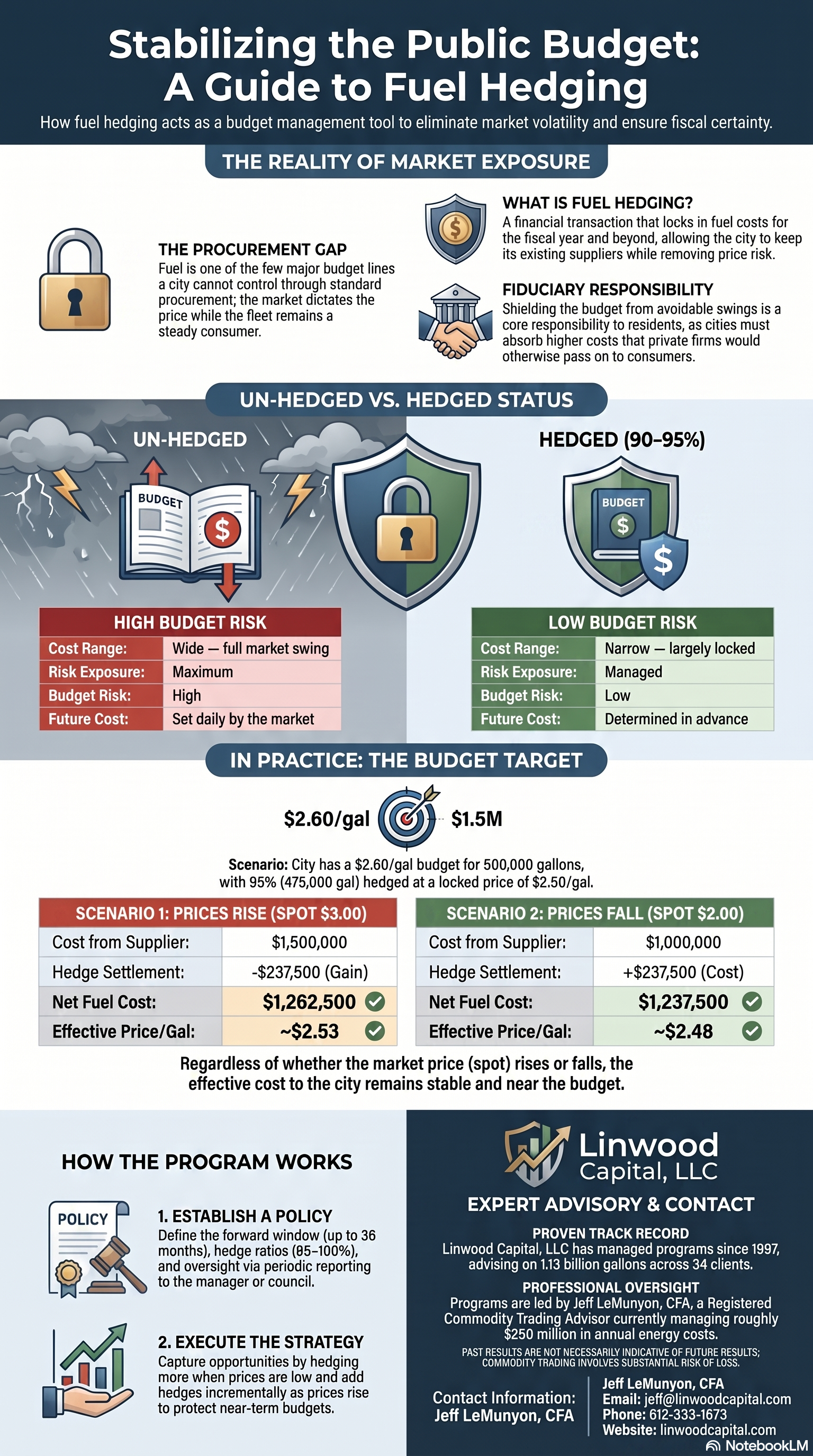
Fuel is one of the few major budgets lines a county cannot control through procurement alone — the market sets the price, and county fleets are among the heaviest, steadiest fuel consumers in local government. Fuel hedging is the standard, low-cost tool for taking that volatility off the table. This brief explains what it is, why it fits public entities, and what a program looks like in practice.
What fuel hedging is:
- Hedging means establishing today the price of fuel that will be purchased and consumed later — locking in some or all your fuel cost for the current fiscal year and beyond. It is a financial transaction layered on top of physical fuel buying; the county keeps its existing suppliers and contracts. Done consistently; it is a form of risk management directly analogous to insurance.
The problem: full exposure to a volatile market:
- A county that does not hedge is fully exposed to global energy prices. Sheriff patrol fleets, fire-rescue and EMS, road and bridge, solid waste, and transit run on fuel every day, so when prices spike the cost lands on the operating budget and the taxpayer with no offset. That exposure is large, recurring, and — unlike many risks — readily manageable. There is no operational advantage to bearing the risk, and the county is not being paid to bear the risk.
The case:
- Over the long run, a consistently applied hedging program has carried low cost — in some periods, a net negative cost. The point is not a promise of future gains; it is that disciplined hedging delivers fuel cost certainly cheaply.
Forecast:
Natural gas prices remain relatively steady as strong inventories and production balance against rising summer demand and higher exports. Unexpected heat waves could create upward price pressure.

Why public entities especially:
- Public operations are unusually fuel-intensive — and counties, with large service areas and sizable law enforcement, emergency, and public-works fleets, especially so. A government also has nowhere to pass fuel-price risk: a private firm may recover higher costs by charging higher prices; a county must absorb them. That makes hedging more valuable for a public entity — and shielding the budget from avoidable swings is a core fiduciary responsibility to residents.
Un-hedged vs. hedged:

Hedging the Price of Petroleum Fuels
A Decision Brief for the County Manager
Fuel is one of the few major budgets lines a county cannot control through procurement alone — the market sets the price, and county fleets are among the heaviest, steadiest fuel consumers in local government. Fuel hedging is the standard, low-cost tool for taking that volatility off the table. This brief explains what it is, why it fits public entities, and what a program looks like in practice.
What fuel hedging is:
- Hedging means establishing today the price of fuel that will be purchased and consumed later — locking in some or all your fuel cost for the current fiscal year and beyond. It is a financial transaction layered on top of physical fuel buying; the county keeps its existing suppliers and contracts. Done consistently; it is a form of risk management directly analogous to insurance.
The problem: full exposure to a volatile market:
- A county that does not hedge is fully exposed to global energy prices. Sheriff patrol fleets, fire-rescue and EMS, road and bridge, solid waste, and transit run on fuel every day, so when prices spike the cost lands on the operating budget and the taxpayer with no offset. That exposure is large, recurring, and — unlike many risks — readily manageable. There is no operational advantage to bearing the risk, and the county is not being paid to bear the risk.
The case:
- Over the long run, a consistently applied hedging program has carried low cost — in some periods, a net negative cost. The point is not a promise of future gains; it is that disciplined hedging delivers fuel cost certainly cheaply.
Forecast:
Natural gas prices remain relatively steady as strong inventories and production balance against rising summer demand and higher exports. Unexpected heat waves could create upward price pressure.
Why public entities especially:
- Public operations are unusually fuel-intensive — and counties, with large service areas and sizable law enforcement, emergency, and public-works fleets, especially so. A government also has nowhere to pass fuel-price risk: a private firm may recover higher costs by charging higher prices; a county must absorb them. That makes hedging more valuable for a public entity — and shielding the budget from avoidable swings is a core fiduciary responsibility to residents.
Un-hedged vs. hedged:
How a program works:
- A program rests on a written policy and a simple operating strategy.

The strategy behind the policy:
- Capture opportunity — hedge more volume further out into the future when prices are low versus historical norms.
- Manage risk — add hedges incrementally as prices rise to protect near-term budgets.
- Keep a minimum hedge — always hold a minimum hedge forward (e.g., one year) for baseline certainty.
- Aim long-term — pursue low overall cost while keeping risk controlled and avoid avoidable mistakes.
What it looks like in practice:
- Assume a $2.60/gal budget, 500,000 gallons in a month, and 95% hedged (475,000 gal) at a locked price of $2.50/gal:

Either way, the effective cost lands within pennies of budget. That is the point: the daily market stops setting up your cost — you do, in advance.
What to expect over time:
- Over long periods, hedging gains and losses tend to sum up to about zero. The value is not beating the market; it is lower volatility, higher certainty, and low expected total cost — exactly what a budget needs.
Getting started:
- Adopt a short hedging policy defining the forward window, hedge ratio, instruments, and oversight.
- Review current fuel volumes and exposure across the bus fleet and facilities.
- Begin hedging incrementally under the policy. Once the policy is in place, the function is largely administrative.

How a program works:
- A program rests on a written policy and a simple operating strategy.
The strategy behind the policy:
- Capture opportunity — hedge more volume further out into the future when prices are low versus historical norms.
- Manage risk — add hedges incrementally as prices rise to protect near-term budgets.
- Keep a minimum hedge — always hold a minimum hedge forward (e.g., one year) for baseline certainty.
- Aim long-term — pursue low overall cost while keeping risk controlled and avoid avoidable mistakes.
What it looks like in practice:
- Assume a $2.60/gal budget, 500,000 gallons in a month, and 95% hedged (475,000 gal) at a locked price of $2.50/gal:
Either way, the effective cost lands within pennies of budget. That is the point: the daily market stops setting up your cost — you do, in advance.
What to expect over time:
- Over long periods, hedging gains and losses tend to sum up to about zero. The value is not beating the market; it is lower volatility, higher certainty, and low expected total cost — exactly what a budget needs.
Getting started:
- Adopt a short hedging policy defining the forward window, hedge ratio, instruments, and oversight.
- Review current fuel volumes and exposure across the bus fleet and facilities.
- Begin hedging incrementally under the policy. Once the policy is in place, the function is largely administrative.